Linggo, Agosto 28, 2016

Lesson 8: Teaching with Contrived Experience

Image result for contrived experience
-These are the edited copies of reality and are used as substitutes for real things when it is not practical or possible to bring or do the real thing is the classroom.

-Designed to stimulate real life situations.

Model
- a reproduction of a real thing in a small scale or a huge scale or exact size- but made of synthetic materials.

Image result for model of contrived experiences
Mock up
- an arrangement of a real device or associated devices, displayed in such way that representation of reality is created.
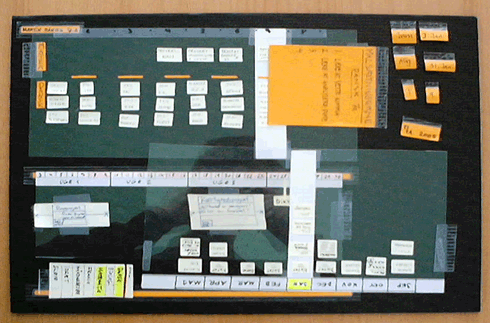
Image result for mock up sample
Specimen
- any individual or item considered typically of a group, class, or whole.
Image result for specimen
Object
- may also include artifacts displayed in a museum or objective displayed in exhibits or preserved insect specimens in science.
Image result for artifacts
Simulation
- a representation of a manageable real event in which the learner is an active participant engage in learning a behavior or in applying previously acquired skills or knowledge.
Image result for simulation

Why do we make use of Contrived Experiences?

1. Overcome limitations of space and time.
2. To edit reality for us to be able to focus on parts of a system that we intend to study.
3. To overcome difficulties of size.
4. To understand the inaccessible.
5. Help the learners understand abstraction.

Ten general purposes of simulations and games

to develop changes in attitudes
to change specific behaviors
to prepare participants for assuming new roles in the future
to help individuals understand their current roles
to increase the students' ability to apply principles
to reduce complex problems or situations to manageable elements
to illustrate roles that may affect one's life but that one may never assume
to motivate learners
to develop analytical process
to sensitize individuals to another person's life role

Lesson 7: Direct Purposeful Experience


These are our concrete and first hand experiences that make up the foundation of our learning.
These are the rich experiences that our senses bring from which we construct the ideas, the concepts, the generalizations that give meaning and order to our lives (Dale, 1969)
Example of Direct Purposeful activities
  Preparing meals

 Image result for preparing meals cartoon 
Making a piece of furniture
Image result for making a piece of furniture
  Performing a laboratory experiment
Image result for direct purposeful experiences and beyond
  Delivering a speech
Image result for delivering a speech cartoon
  Taking a trip
Image result for taking a trip
     In contrast, indirect experiences are experience of other… people that we observe, read or hear about. They are not our experiences but still experiences in the sense that we see, read and hear about them. They are not first hand but rather vicarious.  
         
Why are these direct experiences described to be 
purposeful?
  They are experiences that are internalized in the sense that these experiences involve the asking of questions that have significance in the life of the person undergoing the direct experience.
  These experiences are undergone in relation to a purpose, i.e. learning
  It is done in relation to a certain learning objective.
What does Direct Purposeful Experience imply to the teaching-learning process?

1. Let us give our students opportunities to learn by doing. Let us immerse our students in the world of experience.

2. Let us make use of real things as instructional materials as long as we can.

3. Let us help our students develop the five senses to be full to heighten their sensitivity to the world.


4. Let us guide our students so that they can draw meaning from their first experiences and elevate their level of thinking.

Lesson 6: Using and Evaluating Instructional Materials


Image result for instructional materials clip art
One of the Instructional materials used to attain instructional objectives is field trip.

For an effective use of instructional materials such as field trip, there are guidelines that ought to be observed, first of all, in their selection, and second, in their use.


Selection of Materials
  • Does the material give a true picture of the ideas they present? to avoid misconceptions, it is always good to ask when the material was produced.
  • Does the material contribute meaningful content to the topic under study? Does the material help you achieve the instructional objective?
  • Is the material aligned to the curriculum standards and competencies.
  • Is the material culture – and grades –sensitive
  • Does the material have culture bias?
  • Is the material appropriate for the age, intelligence, and experience of the learners.
  • Is the physical condition of the material satisfactory? An example, it is photograph properly mounted?
  • Is there a teacher’s guide to provide a briefing for effective use? The chance that the instructional material will be used to the maximum and to the optimum is increased with a teacher’s guide.
  • Can the material in question help to make students better thinkers and develop their critical faculties? With exposure to mass media, it is highly important that we maintain and strengthen our rational powers.
  • Does the use of material make learners collaborate with one another?
  • Does the material promote self-study?
Is the material worth the time, expenses and effort involved? A field trip, for instance, requires much time, effort, and money. It is more effective than any other less expensive and less demanding instructional material that can take its place? Or is there a better substitute?


The Proper Use of Materials

P – prepare yourself
Image result for prepare yourself
P – prepare your student
Image result for prepare your student
P – present the material
Image result for present the material
F – follow up
Image result for follow up
•To ensure effective use of      instructional material, Hayden Smith and Thomas Nigel, (1972) book authors on Instructional Media, advise us to abide by the acronym PPPF 
         Prepare Yourself
You know your lesson objective and what you expect from the class after the session and why you have selected such particular instructional material. You have a plan on how you will proceed, what question to ask, how you will evaluate learning and how you will the loose ends before the bell rings.
Prepare your students
Set reasonably high class expectations and learning goals. It is sound practice to give them guide questions for them to be able to answer during the discussion. Motivate them and keep them interested and engaged.
Present the material
Under the best possible conditions. Many teachers are guilty of the R.O.G Syndrome. This is means “running out of gas” which usually results from the poor planning. (Smith, 1972) Using media and materials, especially if they are mechanical in nature, often requires rehearsal and a carefully planned performance.
Follow up
Remember that you use instructional materials to achieve objectives, not to kill time nor to give yourself a break, neither to merely entertain the class. Your use of the instructional material  is not the end itself. It is a mean to an end, the attainment of a learning objectives . So, there is need to follow up to find out if objective was attained to use. 
To ensure that instructional materials serve their purpose in instruction, we need to observe some guidelines in their selection and use. The materials that we select must.
1. Give a true picture of the ideas they present
2. Contribute to the attainment of the learning objective.
3. Be aligned to curriculum standards and competencies
4. Be appropriate to the age, intelligence and experience of the learners.
5. Be in good and satisfactory condition.
6. Be culture sensitive and gender sensitive
7. Provide for a teacher’s guide
8. Help develop the critical and creative thinking powers of students.
9. Promote collaborative learning?
10. Be worth the time, expense and effort involved.
 For optimum use of the instructional material, it is necessary that the teachers prepares:
1. Herself
2. Her student
3. The instructional material and does follow up
4. Promote independent study
Image result for robert gagneRobert Gagne’s nine (9) instructional material in the subject facilitating learning. These are:
   1. Gain attention
   2. Inform learner of objectives
   3. Stimulate recall of prior learning
   4. Present stimulus material
   5. Provide learner guidance
   6. Elicit performance
   7. Provide feedback
   8. Assess performance and
   9. Enhance retention transfer
There is no such thing as best instructional material
Any instructional material can be the best provided it helps the teacher accomplish his/her intended learning objective.
No instructional material, no matter how superior , can take the place of an effective teacher
Instructional materials may be perceived to the labor saving devise for the teachers. On the contrary, the teacher even works harder when she makes good use of instructional material
“You should have a good idea of your destination, both in the over-all purposes of education and in the everyday work of your teaching. If you do not know where you are going, you cannot properly choose a way to get there.”